
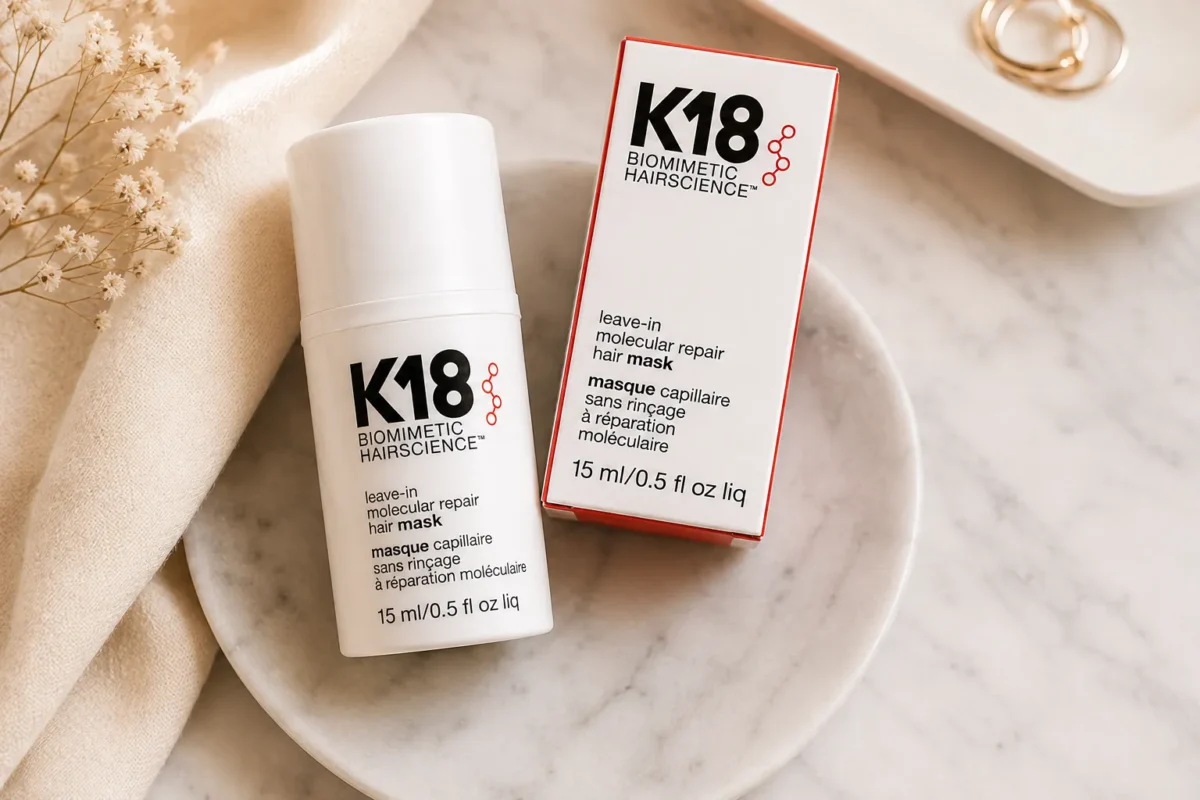
I bought this myself. Not sponsored, no affiliate links.
I used K18 leave-in hair mask for a month on fine hair. What changed, how many pumps to use, and why three was too many.
K18’s Leave-In Molecular Repair Mask promises to reverse hair damage in four minutes, without rinsing, on any hair type. It is also expensive, which is a lot to ask of a small bottle.
I used it for a month on fine, long hair that sits somewhere between straight and slightly wavy.
Short answer: After a month there was less breakage at my ends, more shine, and slightly less frizz. The first couple of weeks I could not honestly say anything had changed. The mistake I made at the start was using too much – three pumps left my hair heavy and weighed down. On fine hair, two is the number, and sometimes one.
What is K18 Leave-In Molecular Repair Mask?
| Type | Leave-in repair treatment, no rinsing |
| Key ingredient | K18Peptide (sh-Oligopeptide-78) |
| Wait time | Four minutes |
| Conditioner | Skip it before applying |
| Scent | Light floral – jasmine and peony |
| My hair | Fine, long, straight to slightly wavy |
| My rating | 4/5 |
K18 belongs to a category called bond builders. The premise is that colour, bleach, heat and chemical treatments break the internal bonds holding hair together, and that these products go in and reconnect them.
The brand says its peptide reaches the keratin chains inside the hair rather than sitting on the surface, and that it addresses damage from bleach, colour, chemical services and heat styling in four minutes, with results building over repeated use.
Read the claims carefully and you will notice they are about strength, softness, smoothness and bounce. Not moisture. That distinction matters later.
Benefits of K18 Leave-In Hair Mask (and the drawbacks)
Benefits
- Less breakage at the ends after a month
- Adds shine without weighing hair down
- Takes the frizz down, though it does not remove it completely
- A light floral scent that fades rather than lingering
- Shortens wash day: four minutes, no rinsing, and it replaces conditioner
Drawbacks
- Very easy to overdo, and too much is worse than too little
- Three pumps left my fine hair heavy for the rest of the day
- Nothing obvious happened at all for the first two weeks
- Expensive for the size, particularly if you have a lot of hair
- Skipping conditioner takes some getting used to if you rely on it to detangle
Who Should Use K18 Hair Mask?
This is built for hair that has been through something. Colour, bleach, chemical treatments, regular heat styling. K18’s own line is that the more damaged the hair, the more dramatic the result – which also means the less damage there is, the less you will notice.
It works on fine hair, but only at the right dose. The formula is light in texture and heavy in concentration, and on fine strands the gap between enough and too much is small.
It is not the product for you if what your hair actually needs is moisture rather than repair. Those are different problems.
How To Use K18 Hair Mask?
These are the brand’s own directions.
- Shampoo, and skip the conditioner. K18 says conditioner leaves a film that stops the peptide reaching the hair.
- Towel dry until damp – the brand describes the target as roughly 65% wet. Dripping is too wet, because it dilutes the product. Dry is too dry, because the cuticle needs to be open.
- Apply one to three pumps, spread between your palms first, working from the ends up to the roots. You do not need to avoid the roots with this one.
- Wait four minutes. No brushing, no styling, no rinsing.
- After four minutes, carry on as normal.
How many pumps? This is where most people go wrong. K18’s guidance is to start with one pump and add half a pump at a time if you have missed sections.
| Hair type | Pumps | What to watch for |
|---|---|---|
| Fine, straight, short to medium | 1 | Weighs down easily |
| Fine, straight or slightly wavy, long | 2 | Start with 1, add half if needed |
| Medium thickness, wavy | 2-3 | Can flatten wave definition |
| Thick or curly | 3 | Apply in sections for even coverage |
| Very long and thick | 3+ | Section the hair, build half a pump at a time |
A note for wavy and curly hair: several reviewers with defined waves found the mask smoothed their hair more than they wanted, losing some of the wave pattern. If your texture is the thing you are trying to keep, that is worth knowing before you buy. Fine straight hair does not have this problem – there is nothing to flatten.
I started with three, which was too much. My hair felt dense and weighed down afterwards. Two was right for my length, and on some washes one covered it. Start low. You can always add half a pump.
How Often Should You Use K18 Hair Mask?
K18’s recommendation is to use it after every wash for the first four to six washes, then drop back to roughly once a week for upkeep.
The reasoning behind the front-loaded start is that this is a progressive treatment – the brand says most people notice something after two or three uses, and that results build with repetition. Using it twice and giving up is not really a test.
There is a limit in the other direction too. Repair treatments used too often can leave hair feeling brittle, so once a week is a sensible ceiling rather than a minimum.
I settled into roughly once a week after the first few washes.
What To Use After K18 Leave-In Hair Mask?
There is a lot of confusion about this, and the answer is simpler than the internet suggests.
Usually, nothing. K18’s own position is that the mask is conditioning enough on its own and works as a light detangler, so a follow-up product is generally not necessary. If your hair is particularly dry, a light leave-in or styling product is an option, but the brand does not treat it as a required step.
I used nothing after it and had no problem at all – no dryness, no straw texture, nothing.
If you want to condition anyway, you can. The brand’s position is that once the four minutes are up, the treatment stage is finished. You can get back in the shower, apply conditioner from mid-lengths to ends, and rinse. You do not need to reapply the mask. Leave-ins, oils and styling products are all fine after the four minutes.
One thing it does not do is protect your hair. There is no heat or UV protection in this formula, so a heat protectant is still a separate step if you are using hot tools.
Why some people’s hair feels like straw afterwards?
This is the most common complaint about K18, and the usual explanation online – that it strips moisture – is not what the brand says.
According to K18, hair that feels dry, sticky or crunchy after using the mask usually means too much product was applied. The formula is highly concentrated, so unlike a normal conditioner or mask, more does not equal better. If hair feels gritty or powdery, that is the same problem.
The other possibility is buildup. Product, oil, or minerals from hard water can coat the hair and stop the peptide getting in, which is why the brand suggests clarifying before your first use if you are a heavy product user or have hard water.
So if it went badly for you: use less, and clarify first. Not more conditioner.
What Does It Feel Like and Smell Like?
The scent is a light floral, jasmine and peony, and it is pleasant without being strong. This is one of the few things nearly every review agrees on.
The texture is creamy and light in the bottle, but it does not behave like a conditioner. Used at the right dose it disappears into damp hair. Used at too high a dose it feels dense, and you can feel the weight of it in your hair for the rest of the day. That was my experience with three pumps.
How Long Does It Take to See Results?
Weeks 1-2. Nothing I could point to honestly. Hair felt slightly smoother straight after washing, but that is true of most products on wash day.
Weeks 3-4. This is where it became easier to tell. Less breakage at the ends, less frizz, more shine.
K18 says most people see something after two or three uses, and that results build with continued use. My own experience was slower than that, but I was also starting from moderate damage rather than anything severe.
Does K18 Mask Work on Damaged Hair?
On mine – fine and long, with moderate rather than severe damage – the clearest change was at the ends. After a month there was noticeably less breakage.
It did not transform anything. My hair did not become a different texture and nothing dramatic happened overnight. Shine and reduced frizz were the visible parts, and they were real but modest.
That fits the pattern in other reviews: the most enthusiastic results come from heavily bleached or chemically processed hair. The more there is to repair, the more obvious the repair.
K18 Hair Mask Side Effects and Precautions
Using too much is the main risk. Three pumps left my fine hair heavy. This is one of the few products where more is actively worse, and overdosing is the single most common reason people think it has not worked.
Overuse can backfire. Repair treatments used too frequently can leave hair feeling brittle. Follow the recommended frequency rather than using it at every wash indefinitely.
No heat or UV protection. Do not treat it as a substitute for a heat protectant.
Pregnancy. K18’s own guidance is to consult your doctor before using it during pregnancy, or if you have concerns about allergies.
K18 vs Olaplex
These get compared constantly, and they are not really the same kind of product.
| K18 vs Olaplex | K18 Leave-In Hair Mask | Olaplex No. 3 |
|---|---|---|
| When | After shampoo, on damp hair | Before shampoo |
| Rinse | No | Yes |
| Time | 4 minutes | 10+ minutes |
| Targets | Keratin chains inside the strand | Disulfide bonds |
| Conditioner | Skip before, optional after | Use after |
| Price | Significantly higher | Significantly cheaper |
The practical difference is convenience against cost. K18 is faster, needs no rinsing and replaces your conditioner, so it fits into a normal wash without adding time. Olaplex takes longer and needs conditioner afterwards, but costs a fraction of the price.
They also describe different targets. Olaplex is built around disulfide bonds; K18 says its peptide addresses the bonds inside the keratin chains as well. Whether that difference shows up in practice is not something anyone can settle from a bathroom.
Plenty of people use both on different wash days, and there is no reason not to.
If you are choosing one: Olaplex if budget matters more than time, K18 if you want the shorter routine and your hair is damaged enough to justify the price.
Is K18 Mask Worth It?
For a month on fine, long hair: it did something, and that something was real but modest. Less breakage, more shine, less frizz.
Buy it if your hair is genuinely damaged. Colour, bleach, heat, chemical treatments. The more there is to repair, the more visible this gets and the easier the price becomes to justify.
Do not buy it if your hair is in good condition. There is less here for it to do, and you will struggle to see what you paid for.
Do not buy it if you will not use it properly. Skipping conditioner, getting the dose right, waiting the four minutes and clarifying first if you have buildup are all part of it. A large share of the disappointed reviews come down to using too much.
So who should use it? Anyone with coloured, bleached or heat-damaged hair who wants a treatment that fits into a normal wash without adding twenty minutes – and who is willing to give it four to six washes, at the right dose, before deciding.
For full directions and the brand’s own dosage guidance, see K18’s official site.
More Articles About Haircare
- Why Hair Gets Frizzy in Humidity (Puffy or Flat Hair Explained)
- Hair Care Routine by Hair Type: The Ultimate Guide for Every Texture
- Leave-In Conditioner vs Regular Conditioner: What’s the Difference?
Disclaimer: This article is for informational purposes only and does not replace professional advice. This review reflects one person’s experience over one month, so your results may differ. Product formulations can change without notice – always check the packaging in front of you.
Written by Pure as Beauty